By Assad Ebrahim, on November 4th, 2018 (258 views) |
 Topic: Education, General Interest, Technology
*New!* (31 Dec 2018) - Added next set of project photos: wearable electronics, I/O lines for generate digital signals, stepper motor control, interfacing with an 8052 microcontroller, building a physical gear demo to illustrate motorized control
Electronics is a gateway topic to modern technology, along with computer programming and applied mathematics. Getting started in electronics is easier than one may imagine and not prohibitively expensive. With the right approach, exploring electronics can begin for children as early as 3 years old.
I’m in the midst of play-testing these ideas with my two children (Jasmine 6 yrs 10 months, Adam 3 yrs 4 months), and a few teenagers of our friends (13 yrs and 14 yrs). Along the way I’m having a lot of fun rediscovering long forgotten ideas myself! Read on for more on the journey plan, and photo gallery of what we’ve built so far.
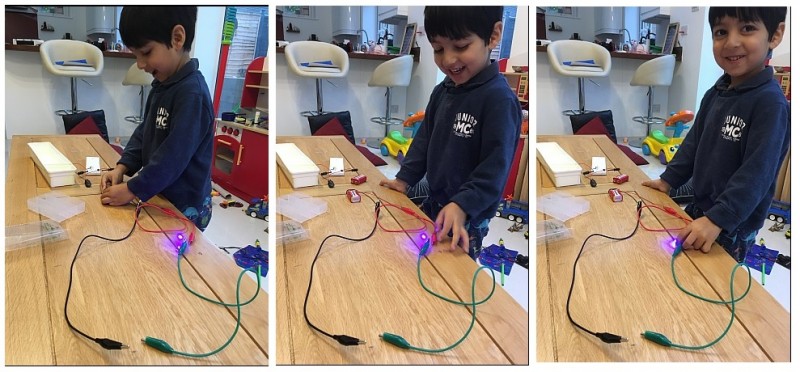 Adam having wired his first circuit and seeing his selected blue LED lit! Continue reading this article…
*New!* (22 Sep 2018) - Turtle Logo v1.5 is available! Expanded features to engage 6 & 7 year olds, and improved usability for 3-year olds. Now with full developer kit included. Suitable from ages 3 years to adult. (900 lines of Forth code).
Previous Release (26 Nov 2016) - Turtle Logo v1.4 - Entirely key operated, suitable for ages from 3 years to adult. 750 lines of Forth code. Algorithmic drawing program with advanced features, incl. macro record & playback, color, and much more! Works on WinXP to Win10.
1. Inspiring the next generation of technology builders.
A challenge faced by both parents and teachers is how to help young children develop a ‘builder’ relationship with technology, instead of becoming increasingly passive consumers of content created by others. The consensus on what’s important for older kids and adults is clear: coding. This enables children to participate in the creation of their own technological “micro-worlds” — environments rich in educational potential.[14]
This autumn, spurred by having our own young children (one aged 4 years, the other 16 months), we began an experiment, the result of which is a Turtle Logo program for Windows computers (freely downloadable) that is simple enough to be accessible for children from 3 years and older, while providing an extensible platform that can grow with the child.
The long-term goal is to enable children to express their creativity, artistry, and natural ‘builder’ impulses using coding, computer graphics, and robotics as readily as the previous generation could using paints, brushes, and building blocks.
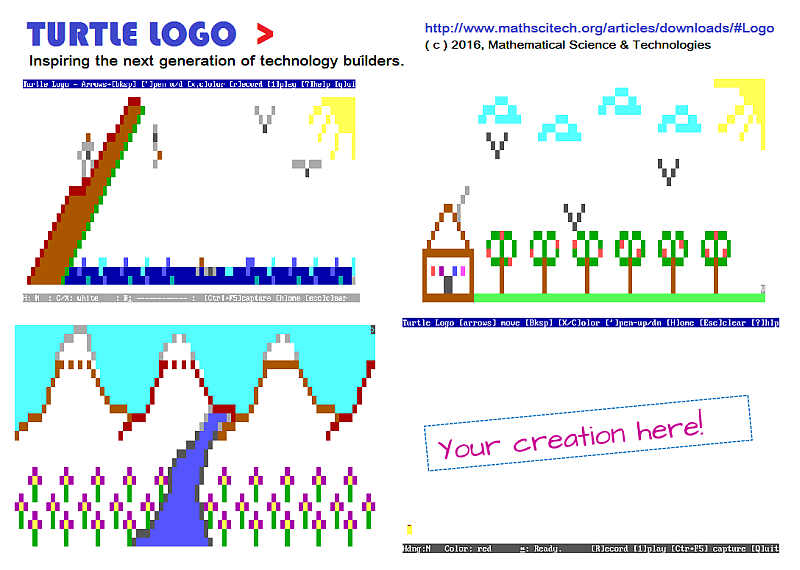 Turtle Logo - Inspiring the next generation of technology builders. Continue reading this article…
By Assad Ebrahim, on May 21st, 2014 (2,638 views) |
Topic: General Interest
Duelling with pistols. If you were the one issuing the challenge, your dilemma was that custom dictated that your adversary be allowed to shoot first. Only then, if you were still able to shoot, would you be permitted to seek “satisfaction”.
How much of an advantage does the first shooter really have? In this article, we build a simple probability model, and implement a numerical model in a few lines of R code.
 Two gentleman face off in the snow. Convention dictates the challenged shoots first. Continue reading this article…
By Assad Ebrahim, on April 14th, 2013 (2,530 views) |
Topic: Infrastructure
Your computer, kitted out with specialised software (mostly free) and configured for efficiency of use, is perhaps the single greatest ‘force multiplier’ that you can have as a Scientist, R&D Engineer, or Mathematician — unless of course you have a large budget and a team of bright minds at your disposal.
With sharp tools, persistence, a some creative ‘joinery’, you can become an ‘army of one’.
Continue reading this article…
By Assad Ebrahim, on November 15th, 2010 (8,088 views) |
Topic: Data Science
(Statistics and Data Mining II)
Automated decision problems are frequently encountered in statistical data processing and data mining. An heuristic filter or heuristic classifier typically has a limited set of input data from which to arrive at a set of conclusions and make a decision: REJECT, ACCEPT, or UNDETERMINED. In such cases, pre-processing the input data before applying the heuristic classifier can substantially enhance the performance of the decision system.
In this article, I’ll motivate the use of a radar-tracking algorithm to improve the performance of automated decision making and statistical estimation in data processing. I will illustrate using the website visitation statistics problem.
Continue reading this article…
By Assad Ebrahim, on September 7th, 2010 (5,763 views) |
Topic: Infrastructure
(Technology Infrastructure Series)
In case you’re taking seriously guarantees about uptime, reliability, or backups advertised by website hosting companies, you should know that most guarantees of service are an idealized concept, especially if you use a low-cost web hosting service. Now, this doesn’t mean you should avoid low-cost web hosts. What you should do is give a little thought to the “what if’s” that may arise, and what you can do before they arise to minimize the pain when they do.
In this article, I’ll go through a few situations you might want to consider, and some options you can use to reduce your risk.
Continue reading this article…
By Assad Ebrahim, on September 3rd, 2010 (11,013 views) |
Topic: Data Science
(Statistics and Data Mining I)
For a variety of reasons, meaningful website visitation and visitor behavior statistics are an elusive data set to generate. This article introduces the visitor statistics problem, and describes seven challenges that must be overcome by statistical and data analysis techniques aiming for accurate estimates. Along the way, we’ll encounter the “Good News Cheap, Bad News Expensive” Paradox of Data Mining — or, why information is often used “as-is”.
This article is the first in a series on algorithms, statistics and data analysis techniques (using free and open source tools) using the visitor statistics problem as a vehicle for illustration.
Continue reading this article…
By Assad Ebrahim, on July 5th, 2010 (5,151 views) |
Topic: General Interest
Abstract
One of the fascinating areas to arise recently in applied mathematics has been Mathematical Finance. From a technical point of view, Mathematical Finance uses a broad range of sophisticated mathematics for its financial models, and relies on state-of-the-art software engineering and computer hardware to implement these financial models, often in real-time.
Whether one is interested in technology or not, there is a kernel of core financial ideas at the heart of the global free market capitalist system that every literate citizen should understand. Whether we agree with their principles or with the inequities that are, arguably, the result, these ideas are in place across most of the world today. A closer look at mathematical finance will offer a better understanding of the mechanics of the modern financial world.
In this article, I’ll motivate the need for financial mathematics through a simplified account of the rise of the modern financial marketplace.
Continue reading this article…
By Assad Ebrahim, on May 20th, 2010 (9,153 views) |
Topic: Toolkit
(Mathematical Toolset Series: TeX & LaTeX, Part 1 of 3)
If symbols, formulas, and equations comprise a large portion of your professional communication, then becoming familiar with the LaTeX / TeX platform should be high on your to-do list. With the right tools and a little practice, the relative ease of creating beautiful documents with TeX may mean that you soon leave your favorite Office suite in favor of TeX for your technical writing.
This article introduces the LaTeX / TeX platform, illustrates its capabilities, and highlights the key differences between using TeX for document preparation and more commonly used word processing systems.
For those that like to know the human side of the tools they use, a little history of TeX, the philosophy motivating its development, and something about its legendary creator, is included.
Continue reading this article…
By Assad Ebrahim, on May 20th, 2010 (12,896 views) |
Topic: Toolkit
(Mathematical Toolset Series: TeX & LaTeX, Part 2 of 3)
EDIT: 25.Oct.2015 - improved templates added.
You can get started with LaTeX / TeX on Windows within an hour. This article walks you through setting up a working platform, provides basic templates for you to produce your first PDF document, and points you to reference materials you may find useful as you advance. The instructions below have been tested against WinXP, Win7, and now Win8.
Continue reading this article…
|
Reading List… Mathematics-Applications
Mathematics-Technical
Mathematics-Phenomenology
Mathematics Education
Advanced Technology
Programming / Software Engineering
|
938 feed subscribers
|

Recent Comments